
RRM Chicago Placement Paths
RRM Chicago is based in Downers Grove and manages federal residential reentry and home-confinement placements. A residential reentry center is a contracted community setting that helps manage the last part of federal custody. Home confinement is also a custody placement, not the same as final release.
This is a distinctive DuPage federal role, but the office address is not proof that a named person lived or was released in DuPage County. Placement information must come from the BOP record and federal case. After BOP custody ends, a federal court may still impose supervised release through the probation system.
| Status | What it establishes |
|---|---|
| RRC placement | Community-based BOP custody |
| Home confinement | BOP custody at an approved residence |
| Released / Not in BOP Custody | Exit from BOP custody only |
| Supervised release | Court-ordered supervision after custody |
Confirm an RRM Release
Use the BOP Inmate Locator. It covers federal prisoners from 1982 forward and accepts federal identifiers or a name search with personal descriptors.
- Search by BOP register number when available.
- Match name, age, race, and sex carefully.
- Read the location and release date together.
- Compare the federal sentencing docket for supervised release.
- Request BOP records when the public line is not enough.
A future date is projected and may change. A past date with no facility, or a released label, means BOP custody ended. The BOP records guide warns that another authority or supervision may remain.
RRM Chicago Office Record
RRM Chicago is listed at 1901 Butterfield Road, Suite 130, Downers Grove. The office manages placements and should not be treated as a public records counter or a detention visiting room. Start with BOP's locator and the federal court record.
RRM Chicago1901 Butterfield Road, Suite 130
Downers Grove, IL
Federal Bureau of Prisons
For a durable custody history, request the BOP record that supports the public locator date. The sentencing court docket supplies the judgment, release conditions, and later supervision action. Those records are more reliable than inferring placement from the office's location.
RRM Chicago Is Not Jail
There is no public RRM walk-in roster. The office does not hold local DuPage arrestees as the county jail does. A person enters the RRM system through a federal BOP sentence and placement process.
VINE is not the federal locator. The DuPage recent-release route also cannot confirm RRM status. Use BOP for sentenced federal custody, and use the court record to determine whether supervision continues after the BOP date.
Federal Release Destination Limits
The BOP locator does not establish where a person went. An RRM address does not establish residence. A released federal person may be subject to supervised release, a state warrant, or an immigration hold. Each claim requires its own source.
If a DuPage jail record shows transfer to a federal authority, preserve that timestamp. Then connect it to the federal docket and BOP record. The two-agency chain is stronger than describing disappearance from the county roster as federal release.
RRM Release Image Source
The official RRM Chicago page identifies the office and its federal role.
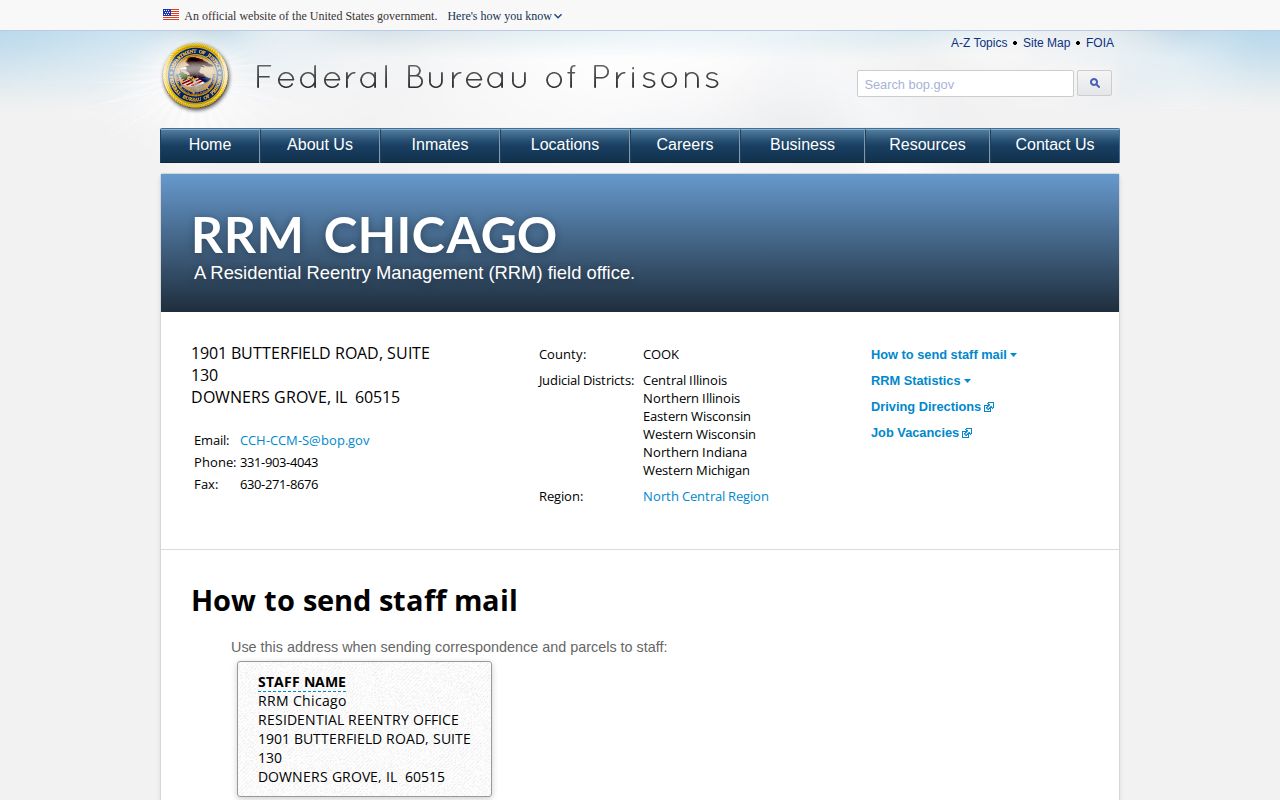
The source supports the office identity, but not the placement or destination of any named person.
Read the BOP Locator
The BOP locator covers federal prisoners from 1982 forward. Search by BOP register number, DCDC number, FBI number, or INS number when one is known. A name search can also use race, age, and sex to narrow results. The detail commonly reports name, register number, age, race, sex, release date, and location. Match more than the name before relying on it.
A future release date is projected. BOP warns that First Step Act recalculation and other sentence administration can move a date. A past date paired with no facility, or a status such as Released or Not in BOP Custody, establishes departure from BOP custody. It does not show the destination. It also does not eliminate supervised release, a state matter, or an ICE detainer.
Community confinement can appear before final release. A residential reentry center placement and home confinement remain within federal sentence administration. Record the displayed location and date separately instead of converting any community placement into a final release claim.
RRM Chicago Court Records
The federal sentencing docket supplies the judgment and the term of supervised release. It may also show later modification, revocation, or termination. The BOP record answers when imprisonment or BOP custody ended. The docket answers what court-ordered supervision follows. Neither record should be stretched to answer the other's question.
For a DuPage-linked person who first appeared in county custody, request the Sheriff's transfer entry. If it names a federal authority, match the date to the federal case and later BOP admission. A county “transfer” is not a community release, and a later federal release does not change the historical county movement code.
If exact BOP release proof is needed after the public result changes, request the underlying federal custody record. Give the register number, full identity, date range, and the specific admission, placement, or release fields sought. Narrow terms make it easier to identify the relevant record without seeking unrelated protected material.
RRM and Other Custodians
Illinois VINE does not replace BOP. VINE integrates participating Illinois jail, corrections, human-services, and court feeds, while the BOP locator is the federal sentenced-prisoner channel. ICE ODLS is a third system for federal civil immigration custody. Choose the system based on the legal custodian, not the person's DuPage connection.
USMS pretrial custody is also distinct. USMS may place a prisoner in a federal, state, local, or private bed and does not operate a comparable public historical locator. If the person was pretrial rather than serving a BOP sentence, use the federal release order and a focused USMS record request. RRM Chicago should not be assumed to manage that pretrial stage.
A verified federal release statement should name its scope. “BOP recorded release on the listed date” is supportable from a matched past locator result. “Released into DuPage County” requires separate destination evidence, and the Downers Grove office address does not supply it.
RRM Release Verification Limits
RRM Chicago manages a network function. It should not be treated as a public residential reentry center address list, a visiting location for every placement, or a local release desk. The official office page establishes the administrative office and its role. It does not confirm that any named person was assigned to a particular contractor, home, or county.
The federal court judgment can state the prison term and supervised-release term. Later docket entries may modify conditions, address an alleged violation, or terminate supervision. A BOP release date and a federal supervision term can therefore coexist. “Released from BOP” is not the same as “discharged from the federal sentence.”
A state or immigration detainer can also affect the next movement. A detainer is a request or notice that another authority may take custody. The public BOP result does not establish whether such a handoff occurred. Obtain the BOP movement record and the receiving authority's record before describing the destination.
When reconnecting with a person, avoid using the administrative office as an assumed contact point. BOP public channels may limit information, and the location field can change. Use the locator for custody status, then rely on appropriate direct contact methods permitted by the agency and person.
Federal Release Proof Afterward
A past locator result can remain useful, but the sentencing docket and agency record are more durable. Save the register number, exact status wording, location, and displayed release date. If the public result later changes, request the supporting custody history rather than relying on a screenshot alone.
For a DuPage origin, preserve the Sheriff's transfer event. For federal custody, preserve the BOP admission, placement, and release record. For post-custody supervision, preserve the judgment and later court orders. Together they form a chronology without assuming that the RRM office itself released the person.
No public source in the research established a fixed RRM processing time, a public placement roster, or a guarantee of release into DuPage. Those gaps must remain explicit. The safest conclusion states only the agency, event, date, and scope that the official record supports.