
DuPage Projected and Actual Release
IDOC calls its prison-exit estimate “Projected Parole Date.” It reflects the present sentence computation, including applicable credit and statutory service rules. “Projected Discharge Date” is a separate field for the expected end of the whole sentence and community-supervision term. An actual Parole Date records a past transition from prison custody. None of these fields should be merged.
A DuPage pretrial detainee has no set sentence-based release date. A judge may enter a release or detention order, but Receiving and Discharge still completes the physical movement and records its time and authority. A person serving a county sentence also follows the county calculation, not IDOC’s public projected-parole field unless the person has entered state custody.
Find a DuPage Projected Release Date
First establish whether the person remains in DuPage jail, transferred to IDOC, or belongs to another system. The DuPage County released-inmates search path explains how to prove the county movement. For a state commitment, use the IDOC number when known and reconcile the state record with the DuPage case.
- Check the DuPage court case and jail record for the commitment, transfer, or release authority.
- Open the IDOC search form and search by IDOC number, full or partial last name, or birth date.
- Match committing county, mittimus or case number, offense, custody date, and sentence.
- Read Parent Institution, Offender Status, Projected Parole Date, and Projected Discharge Date together.
- If the result changes or disappears, request IDOC admission, release, discharge, and sentence-status fields and compare any amended court order.
A parole district plus Parole Date and parole status generally indicates that prison custody ended but supervision continues. A prison or work-release location still means custody. An undetermined discharge field should stay undetermined. Never estimate it.
Illinois Sentence Credit for DuPage Cases
IDOC describes Statutory Sentence Credit, Program Sentence Credit, and Earned Sentence Credit. The controlling version of 730 ILCS 5/3-6-3 depends on the offense, offense date, and sentence. Some eligible determinate sentences use one day of credit for each day served, often called the 50 percent framework. Enumerated offenses can require service of 75, 85, or 100 percent. Covered first-degree murder rules may require 100 percent, and natural-life sentences receive no sentence credit.
Program and earned credits cannot erase a statutory minimum-service floor. IDOC says Earned Sentence Credit is discretionary. Eligibility generally requires more than 60 days in custody and no statutory exclusion, while conduct and other factors affect an award. Eligibility is not a promise. A credit loss can also push a projection later. That is why calculating a date from the sentence reported in news or docket shorthand is unreliable.
The IDOC sentence-credit explanation is the source for the live framework. Its published FAQ and the statute should be read with the actual IDOC profile. The profile is updated when an award changes the calculation, but a saved screen is only a dated observation.
Why DuPage Release Dates Change
A projection changes when the facts used in the computation change. The public date should be read at the time it is needed, then checked again after a court event, credit action, or supervision decision.
| Factor | Possible effect | Confirmation source |
|---|---|---|
| Credit award | May move an eligible projection earlier | IDOC profile and record |
| Discipline or credit loss | May move the projection later | IDOC sentence record |
| Amended mittimus or resentencing | Changes the sentence basis | DuPage signed court order |
| Release-plan issue | Can delay the planned transition | IDOC or PRB record |
| Revocation | Can return a supervised person to custody for recalculation | PRB result and IDOC status |
| Other-agency hold | May change destination without ending all custody | Custodian and destination records |
Confirm a DuPage Release Date
Register through the Illinois VINE inmate check while the person remains in custody. A release or transfer alert reports a change supplied by the feeding agency. It is not the signed release record and does not decide whether another authority took custody. After an alert, refresh IDOC for the Parole Date and status, or contact DuPage Receiving and Discharge for a county event.
For a durable county record, ask the Sheriff for the chronological discharge or transfer entry with date, time, authority, and destination agency if recorded. For state custody, request admission, parole or release, discharge, and sentence-status fields from IDOC. A court order explains legal authority but may precede physical processing.
DuPage County Jail Date Calculations
No county-specific published good-time formula or weekend-release rule was found. Do not transfer IDOC’s state-prison percentages to a DuPage jail sentence. The signed sentencing or release order supplies the legal basis, and DuPage Receiving and Discharge applies the county calculation and records the actual movement.
The state jail inspection supports positive identification and a recorded date, time, and authority at discharge or transfer. Call Receiving and Discharge at 630-407-2255 for current operational information. Published sources do not establish fixed release-processing hours. Weekend and holiday timing should not be guessed from weekday Records Division or court-counter hours.
If the county record shows transfer to IDOC, the release-date question changes systems. First preserve DuPage’s transfer timestamp. Then use the IDOC number, committing county, and mittimus number to match the state record and read its live projection.
DuPage IDOC Date Evidence
The IDOC FAQ explains why projected dates and sentence credits can change.
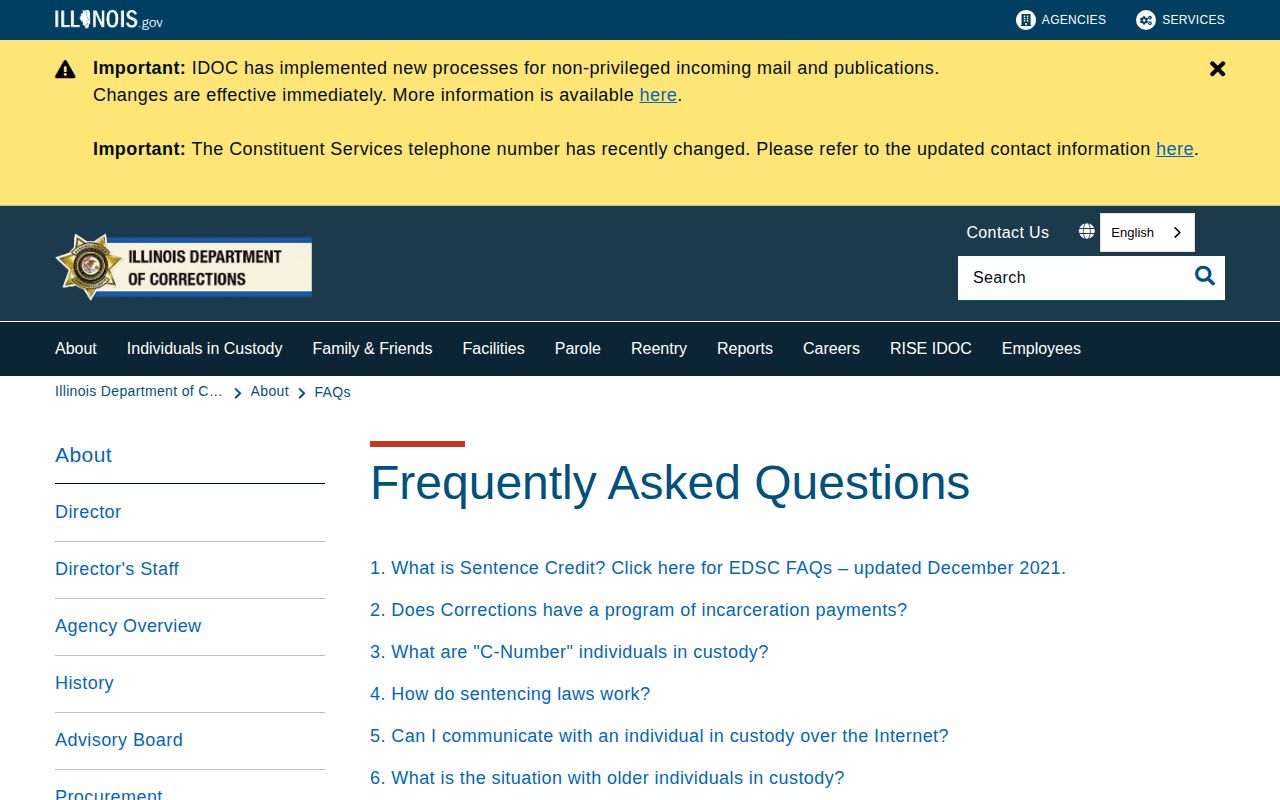
The capture is evidence of the official source, while the live offender profile remains the place to read a person’s current fields.
Read DuPage IDOC Date Fields
A valid match includes more than a name. IDOC results can show the IDOC identifier, parent institution, status, parole district, admission date, sentence, offense, committing county, and mittimus or case number. Compare the DuPage case number and committing county with the state result. This protects against a false match when several people share a surname or birth date.
Projected Parole Date is the live estimate for leaving prison custody under the present computation. Last Paroled Date or Parole Date is historical. Projected Discharge Date ordinarily reaches past the prison exit through the community-supervision term. “Sentence Discharged? Yes” is stronger evidence of completion than a past parole date. Read every field in context.
When status shows Parole with a parole district and past Parole Date, the person has left prison custody for community supervision. That does not mean final discharge. When a result shows a prison location or Work Release Custody, the person remains in a custodial placement even if a future projected date appears.
Missing DuPage Release Date Results
A no-result screen is not proof of release. The name may be misspelled, the person may belong to the county, federal, immigration, or another state system, or the sentence may be fully discharged. Search by IDOC number when available and compare the DuPage docket before reaching a conclusion.
If a former state prisoner no longer appears, submit a focused request to the IDOC FOIA Officer for admission, release or parole, discharge, sentence status, and the authority tied to those dates. Ask for the feasible electronic form and segregable public fields. IDOC publishes its FOIA contact and fee schedule, with the first 50 ordinary black-and-white pages free and later pages at the statutory rate.
For a county-only booking, IDOC will not create a profile merely because the person spent time in DuPage jail. Request the Sheriff’s chronological discharge or transfer record instead. For a federal sentence, use the BOP locator and court docket. For an ICE handoff, use ODLS and the relevant immigration record. Custodian choice is part of an accurate date lookup.
DuPage Court Orders and Release
The DuPage Circuit Clerk docket may show a detention decision, release order, sentence, amended mittimus, jail credit, or later correction. The online docket is unofficial, so order the signed or certified document when exact legal authority matters. A court order can explain why release should occur while the jail record supplies the time it physically occurred.
Resentencing, a corrected mittimus, vacatur, or added jail credit can alter IDOC’s calculation. Compare the date of the court action with the last update in the state profile. Do not calculate from the sentence headline alone because offense dates, statutory versions, multiple counts, credit awards, and minimum-service rules can all matter.
DuPage Parole Decisions and Dates
A projected IDOC date is not proof that PRB granted discretionary parole. Most modern determinate releases follow sentence computation and MSR rules. Traditional parole chiefly concerns indeterminate sentences for older crimes. Eligible youthful-parole review, medical release, revocation, and early final discharge each use a different legal path.
For an actual Board matter, identify the hearing type before reading the calendar. PRB publishes annual en banc dates, institution interview lists, agendas, decisions, revocation schedules, and monthly results. A calendar entry shows that a proceeding is scheduled. It does not guarantee release. An en banc grant can still require release-plan review and processing, while a denial in an indeterminate case may include a separately voted later review date.
A revocation matter can also change a release calculation. The preliminary stage addresses probable cause, not final disposition. A final result can find no violation and resume supervision after plan approval, find a violation but return the person to supervision with or without added conditions, or revoke supervision and return the case to IDOC for recalculation. Appeals can reset, affirm, or reverse a result.
Read the dated PRB decision with the updated IDOC profile. The Board record explains the legal decision. IDOC supplies the resulting status and projected fields. The custodian’s final release record remains the source for the completed physical movement.
Save the observation date when recording a projection. A later profile may lawfully differ after credit, discipline, a court correction, or plan review. Keep both dated observations rather than overwriting the earlier one, then use the final release or parole field to show what actually occurred.
DuPage Release System Limits
Federal and immigration dates require their own sources. A past BOP date with no facility establishes departure from BOP, not the end of supervised release or another hold. ICE ODLS can include many recent releases for a limited period, but a no-result does not prove release. Neither date should be substituted for a DuPage or IDOC calculation. Match the custodian first, record the source date, and keep the conclusion limited to what that agency reports.