
DuPage Released-Inmate Photo Records
A booking photograph records appearance during a specific custody event. Illinois arrest-information law includes a photograph “when and if available,” but that phrase does not guarantee that every DuPage booking produced a public image or that an image remains online. Release does not erase the booking file. It also does not make an old photo a current custody record.
The DuPage Sheriff Records Division maintains jail booking files. A narrow request should identify the person and booking, ask for the photograph if available, and request enough release-file data to connect the image to the correct event. For a state prisoner, IDOC’s image is a separate state-custody photograph. Labeling the custodian and event prevents a county photo from being mistaken for an IDOC release image.
Where DuPage Booking Photos Appear
No current county online source can be promised as a released-person photo archive. The official recently released route is under maintenance, and the live JailTracker fields were not verified. The correct path depends on the agency that created the image.
| Channel | Photo status | Access |
|---|---|---|
| Sheriff recent releases | Not currently verifiable | Maintenance page exposes no fields or photo |
| Sheriff booking file | Ask when and if available | Records or FOIA request |
| IDOC search | Can display state photo | Match IDOC record and DuPage case |
| VINE | May be agency supplied | No statewide image guarantee |
| ISP registry | May show current registry photo | Only for legally required registrants |
| News or third party | May preserve an old image | Verify origin, date, and correction status |
USMS generally does not release mugshots through its public prisoner channel, and the BOP locator does not promise booking photos. A federal or immigration custody record therefore requires a different request path.
DuPage Sheriff App Photo Limits
The Sheriff has an official OCV mobile app, but its published description does not promise released-person records or mugshots. Without live device verification, the app cannot fill the gap left by the maintenance page. Treat the official Sheriff app share page as an agency resource, not proof of a photo feature.
The same caution applies to the website. Current JailTracker checks custody and should not be recast as a historical photo archive. The DuPage 24-Hour Releases page explains the absent official feed and the release-record fallback. A name disappearing from the current roster can mean release or transfer and says nothing about photo access.
The official Android listing shows the Sheriff’s app source.
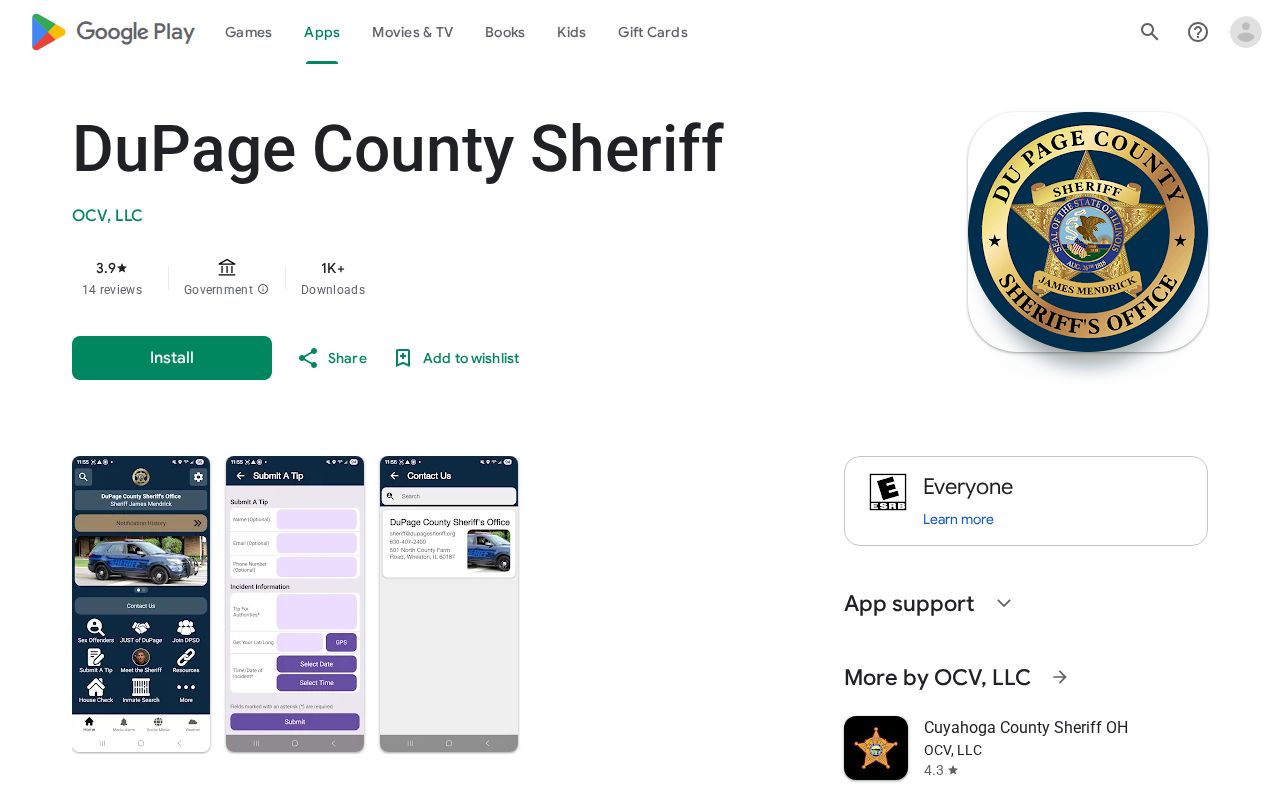
The listing establishes the official app, while no published claim establishes a released-inmate photo gallery.
Request a DuPage Booking Photo
Send a focused request to the DuPage County Sheriff FOIA Officer. Records may be requested by email at FOIA@DuPageSheriff.org, by fax at 630-407-2263, or by mail or in person at 501 N. County Farm Road, Wheaton, IL 60187. The Sheriff page displays a conflicting ZIP in one place, so email or the established Wheaton address avoids repeating that error. Illinois law does not require use of the agency form for an ordinary request.
- Give the full name plus date of birth, booking number, arrest date, or a narrow date range.
- Ask for the booking photograph “when and if available.”
- Also request booking, discharge or transfer date and time, movement code, authority, and destination agency if recorded.
- Ask for electronic delivery and release of segregable public fields with exempt material redacted.
- If the file no longer exists, request the approved retention schedule and destruction record.
The Records Division is open weekdays during published business hours and maintains booking files. Illinois FOIA generally gives an ordinary request a five-business-day response period, subject to one written statutory extension. The first 50 ordinary black-and-white pages are free, then capped at $0.15 per page. No booking-photo-specific price is published.
DuPage Mugshots Outside Official Sources
News reports and third-party collections can preserve an image after an official interface changes. Their copy may omit the original agency, booking date, later disposition, sealing order, or correction. An old image cannot establish that someone remains jailed or under supervision. Trace the image to the original event whenever possible and compare it with the Sheriff, IDOC, or court record.
No commercial mugshot publisher or removal service should replace the custodian. When the official source no longer provides an image, an aggregator is not authority to defeat a sealing or expungement restriction. Use the Clerk and agency correction processes. A registry photo also proves only the narrow registry record, not a DuPage release date.
Correct DuPage Mugshot Visibility
Sealing and expungement alter public access. Under Illinois law, a public inquiry for a sealed record is generally answered as though it does not exist. Sealing retains the record under restricted access, while expungement generally destroys or obliterates qualifying material as ordered. Eligibility is case-specific. Send the entered order and exact image identification to the Clerk or source agency rather than assuming every online copy updates at once.
Illinois also bars covered criminal-record publishers from charging to remove, correct, or modify covered criminal-record information, including arrest photographs. A covered for-profit publisher that receives a documented certified-mail correction demand must follow the statutory process. Exceptions apply, so no outcome should be guaranteed and no fee-based removal service should be endorsed.
Illinois Arrest-Photo Publication Rules
Illinois separates photo availability from social-network posting. The arrest-photo rule narrowly limits law-enforcement social-media posting for specified low-level matters unless the image is used for a permitted missing, fugitive, wanted-person, or person-of-interest purpose. It is not a blanket public-record exemption. It also does not require DuPage to publish every booking photo.
The criminal-record correction statute addresses covered publishers that demand payment. Direct agency requests and documented accuracy corrections remain the sound first steps.
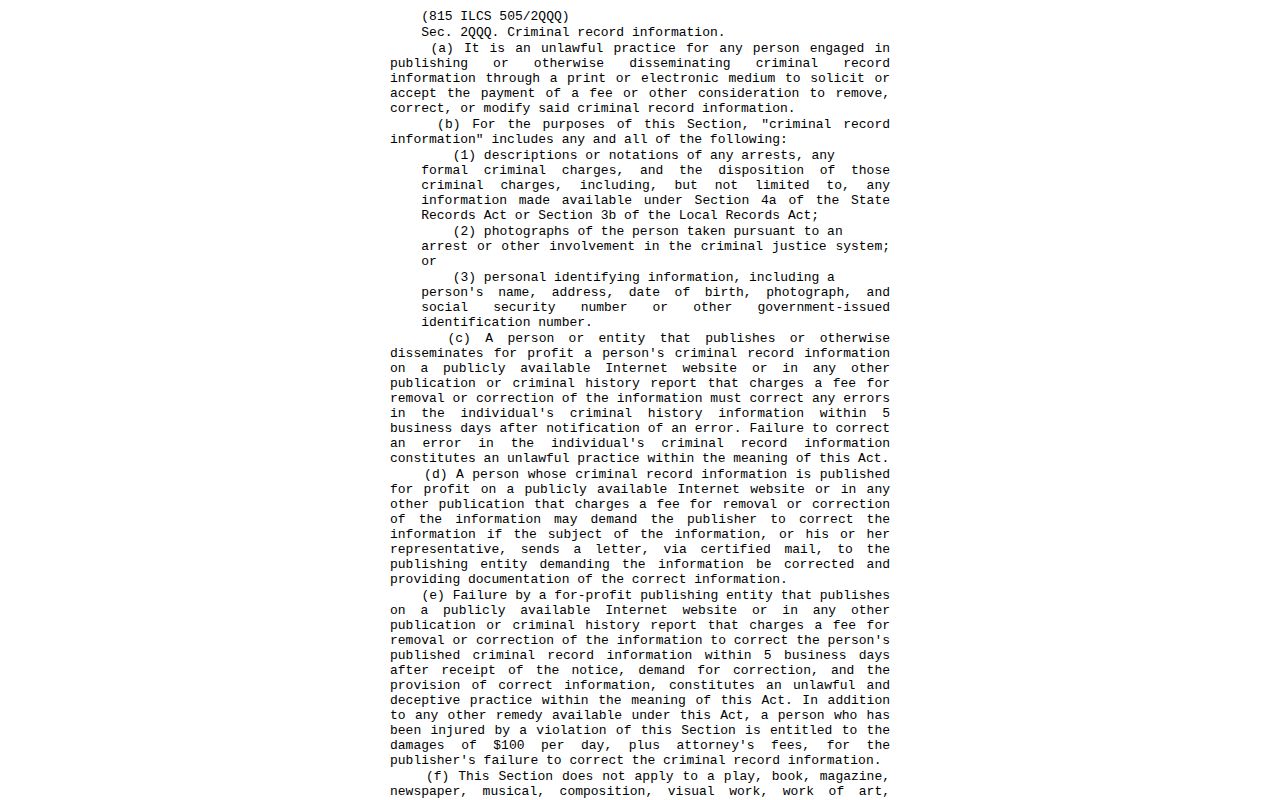
The statute supports an accuracy-focused correction route, not a promise that every publisher or image falls within it.
DuPage Expungement Clinic Path
The DuPage Circuit Clerk scheduled a free expungement clinic for September 12, 2026 and stated that clinic filing paperwork carried no filing cost. That is a real local route for people who may qualify, but it is not evidence that a person was released and should not be described as an annual event.
Use the dated Clerk clinic page for the current event. A court order controls official visibility. The historical photo should not be treated as more authoritative than a later sealing or expungement decision.
DuPage IDOC Photos Are Different
An IDOC detail result can display a state correctional photograph. The IDOC photo directive describes admission and release or discharge imagery with associated identifiers and sentence fields. That image belongs to the state custody record. It is not necessarily the photograph taken during an earlier DuPage County booking.
Match the IDOC number, committing county, mittimus number, sentence, and status before associating a photograph with a person. If the sentence is fully discharged and the public result is gone, request the IDOC release or discharge image through the agency’s FOIA process. Ask only for the image and related public fields needed to identify it, not the confidential master file.
IDOC’s retention evidence is specific. Legacy negatives are permanent, and automated images are held electronically under the directive. That policy does not create a universal retention period for every Sheriff booking photograph. If a DuPage file is unavailable, ask whether it was destroyed under an approved schedule and request the schedule or certificate.
Match DuPage Mugshots to Events
A face alone is not enough. Record the source agency, booking or IDOC number, event date, and custody system. A VINE or registry image may be current for that narrow system yet unrelated to the DuPage booking at issue. A press photo may have been supplied for a different arrest.
The Sheriff release record can connect the county image to admission, discharge, or transfer. The IDOC profile connects a state image to the state sentence. The court disposition explains the case outcome. These sources answer related but different questions, and no image by itself proves release.
What DuPage Mugshots Do Not Prove
A booking photo proves that an agency created or retained an image associated with a custody event. It does not show the final disposition, the physical release time, the release destination, or whether supervision continues. Pair it with the Sheriff discharge or transfer entry and the DuPage court record when those facts matter.
A current registry photo has the same limit. It documents the statutory registry record, not the DuPage jail booking. Presence on a registry does not supply the county release date, and absence from a registry does not establish that no criminal or custody record exists. Use each official system only for the proposition it supports.
When an image has been copied elsewhere, check whether the caption still matches the agency, date, and case. A later correction, dismissal, sealing order, or expungement can change lawful public access. The old copy should not override the originating government record.
Keep a copy of the correction request, delivery proof, source URL, and the exact image caption. Those details help the agency or covered publisher locate the item. State the documented error and attach the court or agency record that supports the correction rather than making a broad removal demand without a record basis.
Update DuPage Official Mugshot Records
If an official page still shows an image after an entered sealing or expungement order, contact the originating office with the order and exact record identifiers. The Clerk can supply the court document, but the agency that controls the image must locate its own publication. Public access may differ across systems while updates are processed. Preserve the request and response so the correction history remains clear.