
DuPage Three-Day List Status
The official DuPage Sheriff Recently Released Inmates page was under maintenance when checked on July 16, 2026. It showed no 72-hour control and no second official three-day feed was found. The page exposed no names, photos, booking numbers, movement types, release times, update frequency, pagination, or retention span. It therefore cannot support a current list of people released during the prior three days.
The missing interface should not be replaced with JailTracker. That service is labeled as an inmate search and checks current county custody. A person can leave that roster after community discharge or after transfer to another custodian. Only the historical release/transfer entry identifies which event happened. The precise local finding is a named release route that is presently unavailable, not proof that the Sheriff never kept such information.
Define the three-day span before requesting data. List an exact starting timestamp, ending timestamp, and local time zone. A vague request for “the last 72 hours” shifts while staff process it and can produce a different answer on each day. Ask which event timestamp controls inclusion. The physical discharge or transfer time is more responsive than the time a clerk entered data, uploaded a page, or closed a file.
Check DuPage 72-Hour Records
For one person, build a short event chain. Start with continued county custody, then review notification and court sources. Search with a full name and add a date of birth, booking number, arrest date, or case number when known. This reduces confusion between people with similar names. Ask for both discharged and transferred events because a request using only the word released could miss the agency’s actual movement code.
- Check the Sheriff’s current JailTracker only to see whether county custody continues.
- Search Illinois VINE for the named person and note the feeding agency, event, and date.
- Review the individual DuPage court case for the order or disposition that may explain the movement.
- Call Receiving and Discharge at 630-407-2255 for current operational facts.
- Request the Sheriff’s chronological discharge and transfer entries for an exact start and end timestamp.
The signed court order and jail movement record should be read together. An order authorizes a legal result. The jail entry records the physical discharge or handoff. If the person entered state, federal, or immigration custody, the destination system becomes the next source. A transfer out of DuPage is not the same as a return to the community.
DuPage Three-Day Record Fields
No fields can honestly be attributed to the maintenance page. A records request can instead seek fields supported by the Sheriff’s booking-file role, Illinois arrest-information law, and state jail inspection standards. Ask for a chronological extract in the agency’s native electronic format when seeking several events. Limit the request to public fields and a precise time range.
| Field to request | Why it matters |
|---|---|
| Full name and booking number | Separates each custody event and reduces mistaken identity. |
| Booking or receipt date | Links the departure to the correct jail stay. |
| Discharge or transfer time | Places the movement inside the requested three-day span. |
| Release type or code | Preserves the Sheriff’s label for the event. |
| Authority or order | Identifies the legal basis for discharge or transfer. |
| Destination agency | Shows where to continue a custody check when recorded. |
| Photo availability | Asks whether an associated image exists without assuming publication. |
For a list of all public events, specify the exact beginning and ending timestamps. Ask for discharge and transfer movements, not full confidential jail files. Redactions may apply, and an agency need not create a new record that does not exist. Accepting a feasible native electronic format can make a broad chronological extract more useful.
DuPage Weekend Release Checks
A three-day request can cover a weekend in one date range, but no working Sheriff product currently promises weekend catch-up. Published sources do not establish a special DuPage weekend or holiday release formula, fixed release hours, or guaranteed posting lag. A valid release order is processed through jail operations, while staff access, court counters, public transit, and ordinary records service can follow separate schedules.
The Sheriff Records Division and DuPage Circuit Clerk public terminals publish weekday hours. Those hours control access to staff or copies, not the legal timing of a release. VINE can report an agency event outside counter hours, but the feeding agency still supplies the data. If a movement occurs near the edge of the requested period, include clear start and end timestamps and confirm the agency time zone.
Note: Do not infer a Monday release merely because the record could not be obtained from a weekday counter until Monday.
Request DuPage Three-Day Extracts
Send a written request through the DuPage Sheriff FOIA channel. The FOIA Officer accepts email at FOIA@DuPageSheriff.org, fax at 630-407-2263, and mail or in-person delivery at 501 N. County Farm Road, Wheaton, Illinois 60187. State law does not require the Sheriff’s standard form for an ordinary request. Provide contact details, delivery preference, exact timestamps, and the fields sought.
Illinois FOIA generally allows five business days for an ordinary noncommercial response and one written extension of no more than five business days for statutory reasons. This cannot produce a real-time three-day feed. The first 50 black-and-white letter or legal pages are generally free, with later pages capped at $0.15 each. Feasible electronic delivery usually carries actual media cost rather than search or review charges.
The successful manifest image documents the official Sheriff release-record fallback.
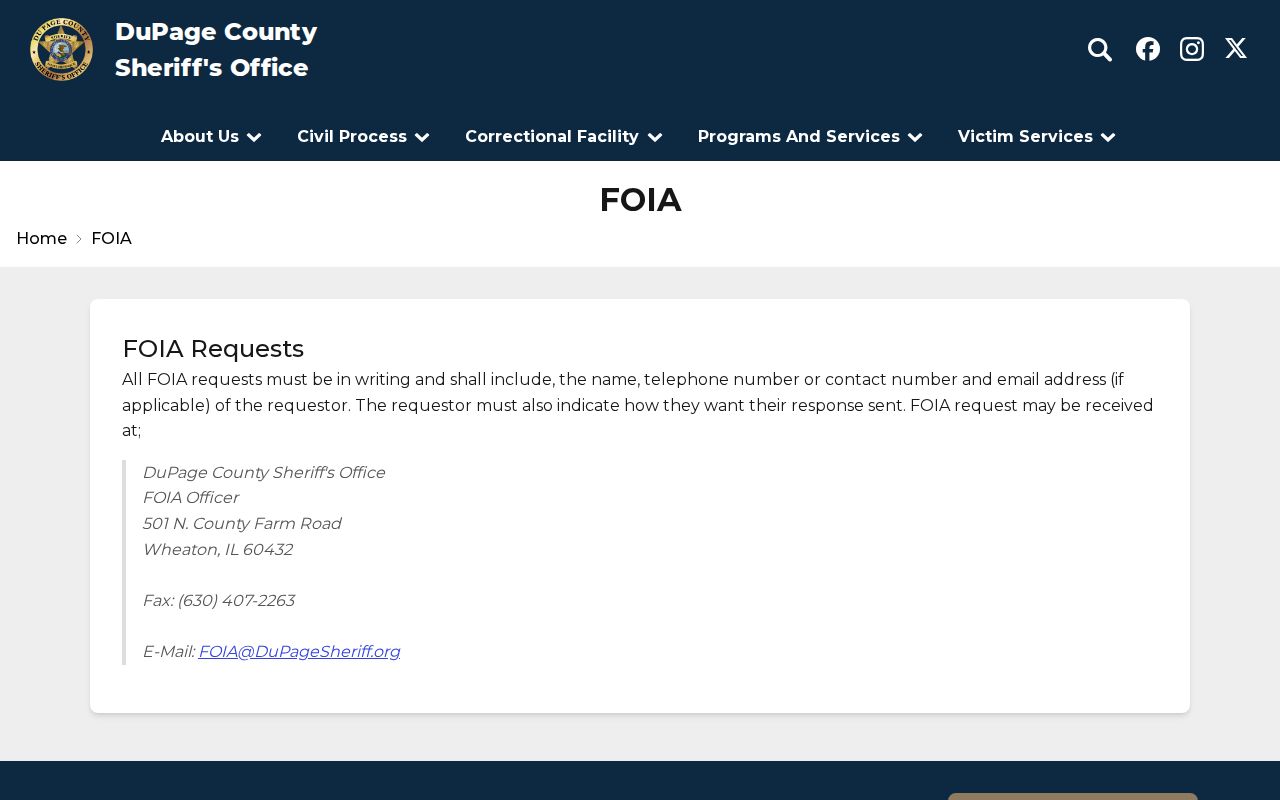
The capture supports the records-request route while the recent-release page provides no public three-day output.
DuPage Release Data Boundaries
A county discharge, county transfer, IDOC parole, final IDOC discharge, BOP release, and ICE release are separate facts. A DuPage jail movement record proves what the county did. If it names IDOC as the destination, search the Illinois Department of Corrections by IDOC number or full name and compare the committing county and case. An active state result may show prison custody or community supervision, neither of which should be recast as a county release list entry.
For a sentenced federal person, the BOP locator can show a past release date or a “Not in BOP Custody” result. That proves exit from BOP, not the end of all supervision or another hold. ICE ODLS covers many recent immigration releases for a limited period and has exclusions and reporting lag. A no-result does not prove release. USMS pretrial custody requires the federal docket, release order, or a focused records request.
| Observed result | What it proves |
|---|---|
| Absent from DuPage JailTracker | County roster absence only |
| Sheriff discharge timestamp | Physical county discharge at the recorded time |
| Sheriff transfer timestamp | County custody ended through a handoff |
| IDOC parole status | State prison custody ended, but state supervision continues |
| BOP past release date | BOP custody ended on the listed date |
Confirm DuPage Release Events
For a durable county record, the Sheriff’s chronological movement entry supplies the exact date and time. The Circuit Clerk can supply the signed detention, release, dismissal, sentence, or disposition order that explains the legal basis. Online docket data is unofficial, so order a certified copy when formal proof is required. Sealed or impounded cases will not be available through ordinary public access.
VINE is useful for a one-person event and alert, but it is not a signed release record. The person’s record should be read with the reporting agency and event date intact. If no result appears, do not infer that release occurred. The 24-Hour Releases page narrows the process to same-day checks, while the DuPage County home page handles a named-person search across all custodians.
When exact timing matters, request both the authority and the physical movement. That paired record shows why the person was permitted to leave and when the custodian acted. It also exposes a transfer that a broad “released” search might conceal.
For several records, reconcile every row by booking number and movement code. A person can have more than one DuPage booking, and one case can involve multiple orders. Keep the date-bounded extract with its agency response so the source and query window remain clear. If a destination agency is listed, confirm the next custody event there instead of treating the county departure as the last event.